
Skip to content
Delta Telematics

Product · Commercial · Production

Musa

A self-hosted billing platform that sits between your products and your payment processors. You buy it once, deploy it on your own infrastructure, and own every tenant, every plan, every invoice.

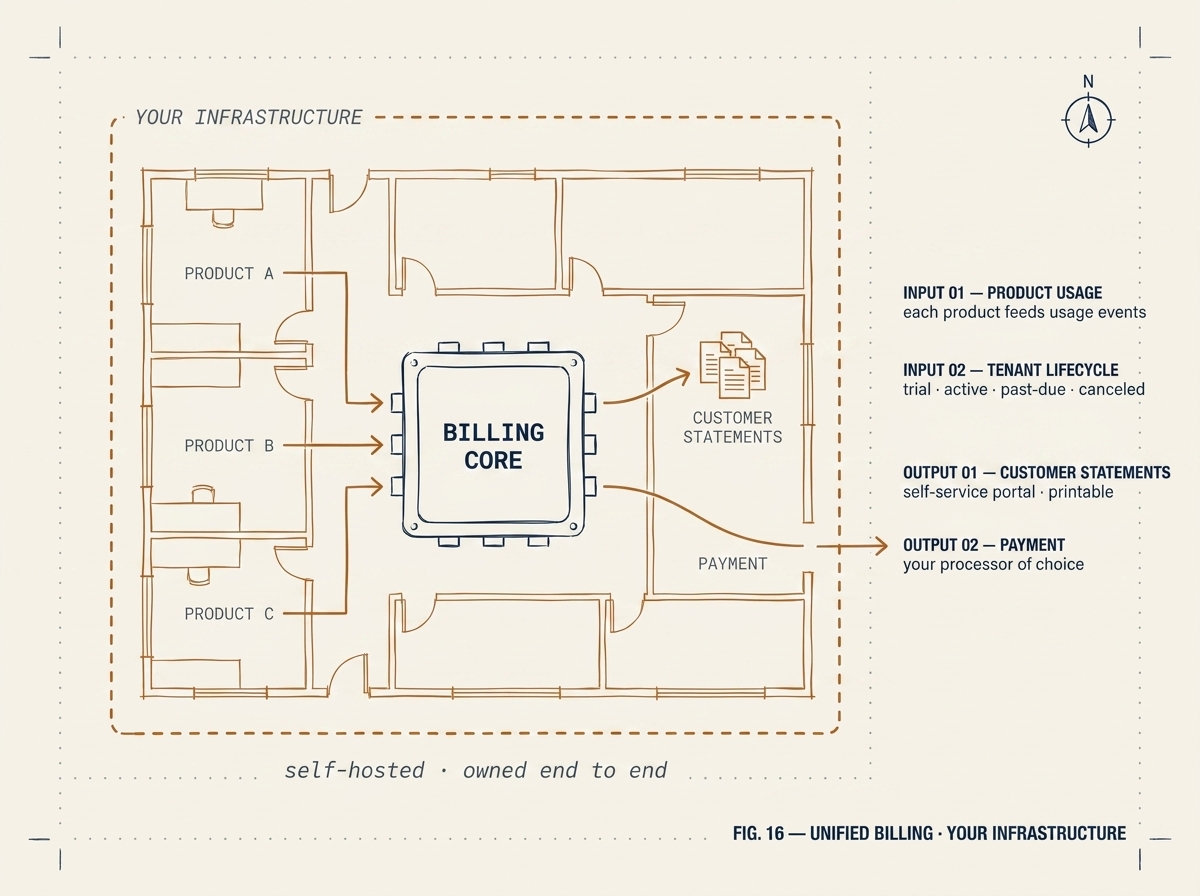
Musa unified billing platform deployed inside the customer's own infrastructure — three products feed usage into a single billing core which produces customer statements and routes to the payment processor of choice, all within a labeled 'YOUR INFRASTRUCTURE' perimeter

The problem

Generic billing is a SaaS subscription that owns your customer.

Off-the-shelf billing-as-a-service gets you paid quickly — but the customer relationship lives in someone else's database, the price model is locked to what their UI exposes, and every product you add to your portfolio means another integration with their tenants table. The fees compound, the lock-in deepens, and the nuance you actually need (per-customer-negotiated tiers, multi-product subscriptions, <50 ms quota enforcement, sovereign data residency) is not on offer.

Musa is the alternative most teams build for themselves on the third try. We sell it as a finished product. You buy it once, deploy it inside your own infrastructure, and operate it the way your business actually works — with as many products, plans, and processors as you need, with no recurring percentage of revenue going to a billing vendor.

What you get

A billing platform, on your infrastructure, end to end.

Multi-product, multi-tenant

One billing core. Any number of products. Any number of tenants.

Each product registers itself with its own pricing tiers, plans, and connectors. Tenants are scoped per product so cross-product data leakage is structurally impossible. New products plug in, no schema change.

Sub-50 ms quota enforcement

Performance-critical checks never slow the user.

A cache-backed quota engine answers "is this call within plan?" in under 50 milliseconds — so you can put quota checks on the hot path of every API call without paying a perceptible latency tax.

Multi-provider payment

Bring your own processor. Switch when the rates do.

A pluggable gateway layer means the payment processor is your choice, not ours. New processors plug in without touching the core. Switch processors per market, per product, or per customer.

Embeddable billing widgets

A widget library that turns your product into a billing surface.

Drop a plan-selection widget into your product UI. Drop a self-service portal widget into your customer dashboard. Drop a usage panel into your operations console. The widgets call the billing core directly; you don't build a billing UI from scratch.

Lifecycle + dunning

Trial, active, past-due, suspended, canceled — with recovery built in.

Tenant lifecycle is a state machine you don't have to write. Failed-payment dunning, retry schedules, grace windows, suspension and recovery — all configurable per product.

Audit-grade invoicing

Versioned plans. Recomputable invoices. Disputed-line workflow.

Plans are versioned, so a prior month's invoice is recomputable from the schedule that was in force. Disputed lines carry an audit-trail attachment so resolution does not depend on operator memory.

Procurement

One-off licence. Yours to run, yours to extend.

Musa is sold as a one-off purchase, not a subscription. You receive the binaries, the dashboard, the widget library, and a deployment package designed to run on your own infrastructure. Annual support and upgrades are optional and priced per deployment, not per transaction.

We use Musa ourselves — it is the billing layer behind the rest of the Delta product family. The same code base ships to customers. There is no "hosted Musa" that we run on your behalf and no SaaS variant where we hold your customer data.

Self-hosted billing, done

Buy once. Deploy on your infrastructure. Own every customer.

Tell us your product portfolio, your usage model, and your residency constraints. We'll come back with a deployment plan and a price for the licence.

Talk to sales